EPS to PDF Converter
Share your artwork with anyone without asking recipients to install specialist design software.
Supports EPS
Size up to 100 MB
How to convert EPS to PDF
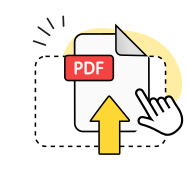
Upload your file
Select your EPS file from your device or drag it into the upload area to start.
Convert automatically
Our online tool processes the source data and renders a clean, high-quality PDF for you.
Download your PDF
Save the finished document to your device, ready to print, email, or archive straight away.
Explore more OnlyDoc tools


 Expert conversion tools
 Easy e-signatureAI-powered tools
Turn document text into other languages in just a few seconds.

Reduce file size while keeping text and visuals clear.

Recognize text to make scanned files searchable.
Compress file size to 100KB keeping text and visuals clear.
What you get from our free EPS to PDF converter
Sharp, scalable output

Vector graphics and illustrations keep their clarity at any file size, with no pixelation in print or on screen.
Secure handling

Your uploads are handled securely throughout the process. Your privacy is protected from start to finish.
Universal readability
A PDF opens on every device and OS without specialist software, making your content easy to share.
Any device, any platform

Use our tool on any device, including Windows, macOS, Linux, iOS, and Android, with no compatibility issues.
No viewer needed

EPS requires specific software to open; PDFs open natively. Convert once and share with anyone, everywhere.
Free of charge

Use our EPS to PDF converter free of charge. No account, no subscription, no limit on tries.
Frequently asked questions
What is an EPS file?
EPS stands for Encapsulated PostScript, a graphic file format that contains text and images expressed as mathematical paths and curves rather than bitmap pixels. Unlike raster formats such as JPEG and PNG, a vector image inside an EPS scales without quality loss at any size. The format is used across the design industry for logos, illustrations, and press-ready artwork, developed by Adobe Systems and used in applications like Adobe Illustrator, CorelDRAW, and Inkscape. Many legacy assets and print suppliers still rely on vector graphic files stored in this format. Because most people cannot open EPS files without specialist software, converting to a universal type like PDF is the most practical way to share your work.
Does your tool preserve image quality?
Yes. The original paths, curves, and layered artwork from your source are faithfully rendered in the output PDF file. The resulting document is resolution-independent, so it looks sharp whether displayed at thumbnail size or printed large. Embedded fonts and complex graphic elements carry through cleanly. The final image quality in the output is equivalent to what you see in the original, making this ideal for logos, icons, and print-ready material where fidelity is critical.
What happens during the conversion?
When you upload a file, our file converter reads the source data, including all paths, curves, and graphic elements. The conversion process transforms this content into a standard PDF file that preserves every detail from the original. The resulting document maintains the resolution-independent nature of the artwork, meaning it scales cleanly for both screen display and high-quality print output. The entire conversion from EPS format to PDF format happens automatically, with no manual configuration required on your part.
Why convert to PDF rather than keep the original?
EPS requires a PostScript interpreter or a dedicated design application to open natively. PDF stands for Portable Document Format and opens in any standard PDF reader on any operating system, including web browsers, with no additional software needed. Converting your EPS file to a PDF file preserves the page layout exactly as in the original. This broad compatibility is one of the main reasons designers want to convert their work: sharing is far simpler when recipients do not need specialist tools to view the content.
What is the best way to convert your EPS?
The best way to convert your EPS file is to use our online file conversion service, which requires no download software. You do not need a separate app for file conversions; simply upload and the result is ready in seconds. Converting EPS to PDF takes seconds on any device and OS, including desktop, tablet, and smartphone. No account, no registration: you can easily convert whenever you need. Get your EPS to PDF for free every time.
Can I convert EPS files on any device?
Yes. Our online file converter works entirely in the browser, so you can use it on any device and OS, including Windows, macOS, Linux, iOS, and Android. There is nothing to install and no account required. Upload your file, and the result is ready in seconds. EPS to PDF conversion online works the same regardless of which platform you use, and the output quality is identical everywhere. Whether you need a quick manual upload or an API integration for automated workflows, the results are consistent.
Is the EPS format still widely used?
EPS remains a staple in the print and prepress industry, especially for logos, illustrations, and other vector artwork. It was developed by Adobe in the 1980s as part of the PostScript language family and is still accepted by most professional design and printing workflows. However, many people outside the design world cannot open EPS files without specialized software, which is why it helps to convert EPS file to PDF online free of charge — PDF is universally readable and preserves the vector quality of the original.
Can I handle large or complex files?
Our tool supports uploads up to 100 MB. Most illustrations, multi-layer artwork, and print-ready assets fall well within this file size limit. Very large uploads may take slightly longer to process, but the output quality stays consistent. If your source contains embedded high-resolution raster images, flattening or relinking those in your design application before uploading can reduce the size significantly. For standard logos, icons, and illustrations, the file conversion completes within seconds.
What other file types can I get?
Our platform offers a growing range of conversion tools beyond EPS to PDF, and we add new file types regularly. Visit our website to see which formats are currently available. PDF remains the most universally accepted document type for professional sharing because it preserves artwork and conforms to an established ISO standard. Recipients can open and preview it in any standard reader without needing to download anything.