PDF to WebP Converter
Get web-ready visuals from your documents: compact, sharp, and optimized for fast loading on any site.
Supports PDF
Size up to 100 MB
How to convert PDF to WebP
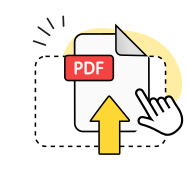
Upload your PDF
Select your PDF or drag it directly into the upload area.
Set output options
Choose your quality level: higher gives sharper results; lower reduces the size further.
Download your results
Save the WebP visuals to your device, ready to use on the web immediately.
Explore more OnlyDoc tools


 Expert conversion tools
 Easy e-signatureAI-powered tools
Turn document text into other languages in just a few seconds.

Reduce file size while keeping text and visuals clear.

Recognize text to make scanned files searchable.
Compress file size to 100KB keeping text and visuals clear.
Benefits of using our PDF to WebP converter
Compact, web-ready results

WebP keeps files compact without sacrificing visual quality, making it ideal for fast-loading web pages.
Secure handling

All transfers use encryption and are handled securely. Our platform is GDPR-compliant and verified by Google Safe Browsing.
High-quality output

Convert PDF to WebP and get sharp, clear results that faithfully represent your original content.
Any device, any OS

Our converter runs on any device and operating system, with no software installation required.
Fast results

The process completes quickly, so you get your WebP images back in seconds without sitting through long waits.
Free to use

Use our PDF to WebP converter free of charge. No account, no subscription, no hidden fees at any stage.
Try our PDF to WebP converter free of charge
Frequently asked questions
What is WebP?
WebP is an image format developed by Google and introduced in 2010. It produces smaller results than older types like JPEG, PNG, and GIF while maintaining comparable or better visual quality. WebP achieves this through advanced algorithms that handle both lossy and lossless encoding, as well as transparency and animation. The result is a practical choice for web publishing, as compact files directly translate to faster page load times and lower bandwidth. For developers, the process is also accessible via API integrations for automated workflows. WebP is an image format supported by Chrome, Firefox, and all major web browsers.
Why convert PDF to WebP?
PDF is a document format built for portability and print fidelity, not for the web. PDFs are often large, require a dedicated viewer, and are not directly embeddable in web pages. The best way to convert PDF to WebP online is to use a tool that handles the process automatically, without requiring desktop software or technical setup. Our free online tool is accessible from any device, making it a cost-effective solution for digital publishers, developers, and designers who need web-optimized visuals. The portable document format preserves layout precisely, but once you need that content on a webpage, WebP is the lighter, faster alternative.
Can I convert PDF into images on my phone or tablet?
Yes. Our converter works in any modern mobile environment, so you can convert your PDF files on any device or operating system, including iOS and Android smartphones and tablets. There is nothing to download and no account to create. Open the page, select your PDF, and the WebP result saves directly to your device. The quality is the same whether you run the process on a phone, a tablet, or a desktop computer, and it takes the same number of steps regardless of which platform you use.
Is my data secure during the process?
Yes. Your data is protected at every stage. Our platform uses encryption for all transfers and is GDPR-compliant. The site is verified as safe by Google Safe Browsing. If you are processing sensitive PDFs, such as legal records or confidential reports, you can do so with confidence that strong safeguards are built in.
Will text and pictures look clear in WebP?
Yes. Our converter renders each PDF page as a high quality visual before encoding it as WebP. Text, diagrams, charts, and photographs are all captured clearly in the output. WebP preserves fine detail, including JPEG-like clarity in its lossy mode and pixel-perfect reproduction in lossless mode. For content with small text or intricate graphics, choosing a higher quality setting will produce sharper results. Keep in mind that WebP is a raster type, so text in the result is not selectable as it would be in the original PDF.
What is the difference between lossy and lossless?
WebP handles two distinct modes. Lossy encoding reduces weight by selectively discarding data that is less perceptible to the human eye, similar to how JPEG works but with better clarity at the same weight. The alternative preserves every pixel exactly, producing larger files that are visually identical to the source. Images in both lossy and lossless WebP are viewable in all major browsers. For web publishing, the first mode at a high setting usually strikes the best balance. For archival purposes or design workflows requiring precise reproduction, the second mode is the better choice. You can adjust compression quality through the output options before saving.
Can I use WebP images for printing?
High-resolution WebP files can be printed, though PDFs are usually better suited for full documents intended for print. WebP is optimized for digital display and web delivery rather than print production workflows. If you need content for both web use and printing, keeping the original PDF for print while using the converted WebP for digital channels is the most practical path. For casual printing of a single page or illustration, a high-quality WebP result will produce acceptable results on a standard printer. If you need a different type of result, check our related tools and related converters on our website.
Is there a size limit?
Our converter handles PDFs up to 100 MB. Most single-page and multi-page documents fall well within this range. Very large inputs with many pages or embedded high-resolution content may approach the limit. If your input is particularly large, consider splitting it into smaller PDFs first. For typical use cases, including product sheets, slides, reports, and web graphics, standard PDFs process without issues. You can handle multiple files by uploading them individually; our tool is free and has no restrictions on repeated use. The page range is processed in full unless the input exceeds the limit.