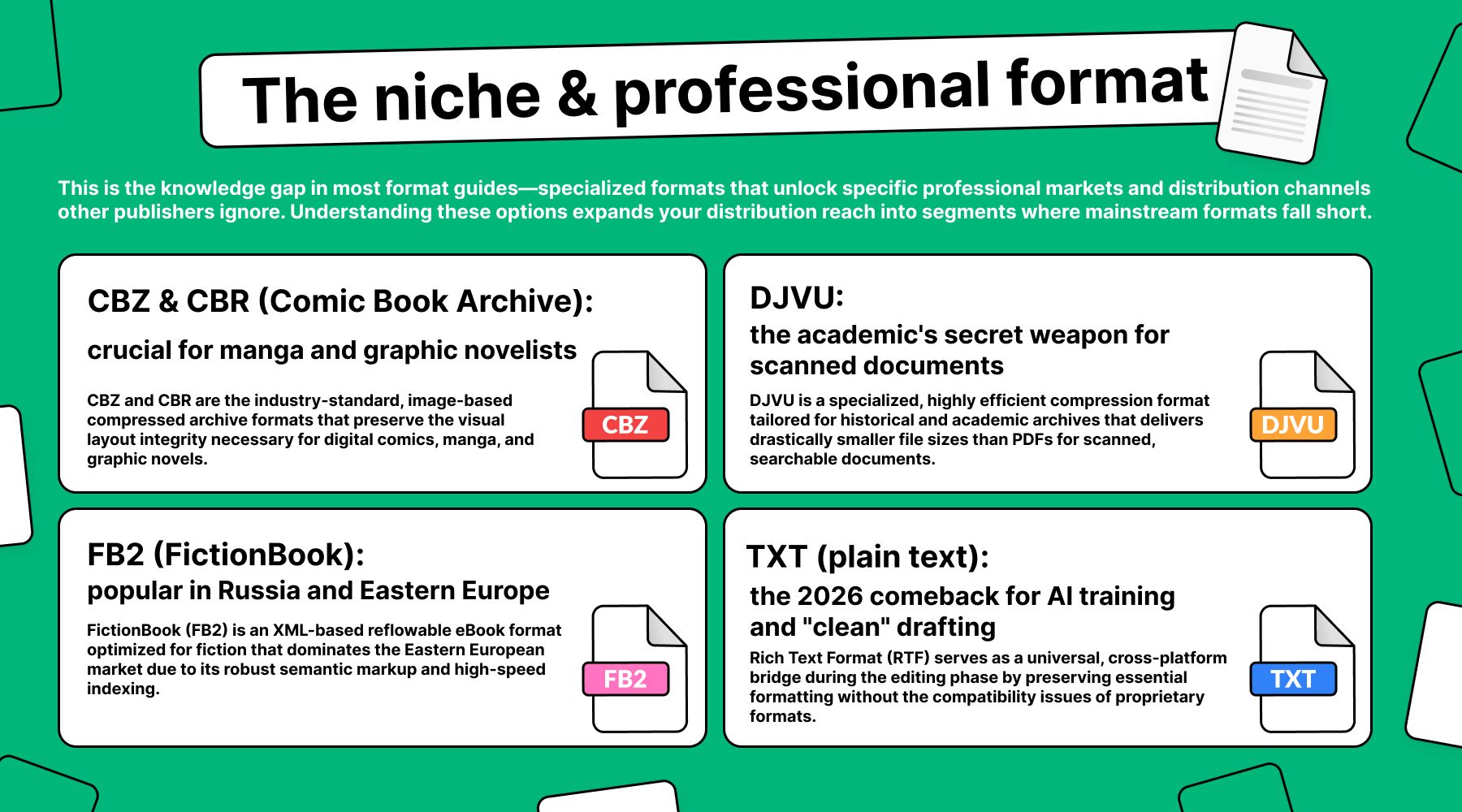
This is the knowledge gap in most format guides—specialized formats that unlock specific professional markets and distribution channels other publishers ignore. Understanding these options expands your distribution reach into segments where mainstream formats fall short.
CBZ & CBR (Comic Book Archive): crucial for manga and graphic novelists
CBZ and CBR files are essentially ZIP and RAR compressed file archives containing sequential JPEG or PNG images. Each page of your comic or graphic novel is saved as a separate image file, then bundled into a single archive that comic reader applications process in order. The format is the industry standard for digital comics, manga, and graphic novels across platforms like ComiXology and dedicated comic reader apps.
Creating CBZ files requires no specialized software—just export your artwork as numbered image files (001.jpg, 002.jpg, etc.) and compress them into a standard ZIP archive, then rename the .zip extension to .cbz. RAR compression produces CBR files with slightly better compression ratios. The simplicity makes comic book archive formats accessible to independent creators without technical expertise.
Reader applications designed for comics handle these formats natively, providing panel-by-panel viewing modes and page transition effects. The image-based approach preserves artwork quality and layout integrity better than attempting to force comic pages into reflowable text formats. If you're publishing sequential visual narratives, CBZ and CBR are non-negotiable format choices.
DJVU: the academic's secret weapon for scanned documents
DJVU compresses scanned document format files to 3-10x smaller sizes than equivalent PDF files while maintaining comparable image quality. The format was developed specifically for archiving historical documents, academic papers, and ancient books in digital form. University libraries, research institutions, and academic publishers use DJVU extensively for digitized manuscript collections.
The compression advantage becomes critical when storing large document collections or distributing files over bandwidth-limited connections. DJVU's OCR layer captures text content separately from the page image, enabling full-text search while preserving the visual appearance of historical sources. The format handles multi-page documents more efficiently than PDF for scanned content.
Academic distribution and archival projects should evaluate DJVU before defaulting to PDF eBooks. Readers need dedicated DJVU viewer software, limiting mainstream consumer adoption, but within scholarly circles the format is widely recognized and supported. If you're digitizing research materials or historical documents, DJVU delivers superior file size economy without sacrificing scholarly utility.
FB2 (FictionBook): popular in Russia and Eastern Europe
FictionBook is an XML-based reflowable format optimized for fiction. The format enjoys dominant market share in Russia, Ukraine, and Eastern European countries where specialized eBook ecosystems developed independently from Western standards. FB2's structure supports high-speed indexing and robust metadata management, making it ideal for large library collections.
The XML foundation allows rich semantic markup that preserves authorial intent for styling and structure. FB2 handles poetry, footnotes, and complex document hierarchies better than many mainstream formats. Typography support includes proper quotation marks, emphasis, and language-specific character handling critical for Cyrillic and Latin text.
If you're targeting Russian or Eastern European markets, distributing in FB2 format alongside EPUB is essential. Regional reading apps and platforms expect FB2, and attempting to serve only Western formats creates friction for local readers. The format's metadata richness also benefits catalog management for publishers managing extensive backlists.
TXT (plain text): the 2026 comeback for AI training and "clean" drafting
Plain text files contain zero formatting—just characters, line breaks, and perhaps basic punctuation. TXT files have experienced a resurgence in 2026 driven by two distinct use cases: AI training datasets and minimalist manuscript drafting. Natural language processing systems require clean text corpora stripped of styling markup, making the plain text file format preferred for model training.
Writers increasingly adopt plain text for distraction-free drafting before applying formatting in later production stages. The smallest possible file sizes and universal compatibility across literally every device make TXT the most portable format. Any computer, smartphone, or tablet can open and edit plain text files without specialized software.
The format's limitations are its strength—no styling overhead, no proprietary encoding, no compatibility concerns. Manuscripts drafted in TXT import cleanly into any word processor for formatting and styling. If you're preparing training data or want the absolute simplest writing environment, plain text delivers universal access without technical barriers.
RTF (Rich Text Format): the "universal donor" for cross-platform editing
Rich Text Format preserves basic formatting like bold, italic, headings, and paragraph styles while remaining openable by virtually any word processor on Windows, Mac, Linux, and mobile platforms. RTF sits between plain text and fully-styled document formats, maintaining essential structure without the compatibility problems of proprietary file formats.
The format functions as the universal donor for manuscripts that need editing across different software platforms. An editor using Microsoft Word on Windows can exchange files seamlessly with a collaborator using Pages on Mac or LibreOffice on Linux. RTF strips away advanced features that cause conversion problems while keeping the formatting elements necessary for manuscript work.
Publishers managing multi-author projects or working with freelance editors across different software ecosystems benefit from RTF's cross-platform reliability. The format is never the final distribution format, but it excels as an interchange format during editing and revision phases before converting to EPUB or PDF for publication.
These formats are dying or dead—don't use them for new publications. Existing files in these formats should be converted to modern standards before distribution.
MOBI: Amazon has retired it
Amazon officially deprecated MOBI in August 2023, and Kindle Direct Publishing no longer accepts MOBI file uploads. The format served as Amazon's primary Kindle format from 2007 through 2022, but technical limitations around typography and accessibility prompted the platform migration to KPF. Older Kindle devices purchased before 2014 can still read MOBI files, but new books distributed through KDP are delivered exclusively as KPF.
If you have existing MOBI files in your archive, they're obsolete for new distribution purposes. Convert them to EPUB format as your source file and re-upload through KDP to generate the modern KPF version. Attempting to distribute MOBI files through channels other than Amazon encounters compatibility problems with current-generation e-readers.
The format change is complete—MOBI is historical infrastructure, not a viable publication standard. Authors should update their workflows to treat EPUB as the source format for both wide distribution and Amazon-specific sales through automated conversion. Clinging to MOBI limits your books' technical capabilities and future compatibility.
AZW and AZW3 are proprietary Amazon formats with Digital Rights Management encryption that restricts reading to authorized Amazon Kindle devices and applications. AZW3 offered improved formatting capabilities compared to the original AZW file format, supporting better typography and embedded fonts. Both formats are being phased out in favor of KPF as Amazon's ecosystem evolves.
The encryption makes these formats impractical for any distribution outside Amazon's walled garden. Readers can't transfer purchased AZW files to non-Kindle devices without violating Digital Rights Management terms. Publishers who choose AZW formats lock themselves into Amazon-only distribution, surrendering access to Apple Books, Kobo, and other retailers.
Avoid creating new content in AZW or AZW3 formats. The future trajectory points toward KPF for Amazon distribution and EPUB for everywhere else. Starting new projects with these legacy proprietary formats creates unnecessary technical debt and limits your distribution flexibility. Amazon's own platform has moved beyond them—publishers should follow that lead.
LIT & PDB: historical artifacts from the early 2000s
Microsoft Reader (LIT format) was discontinued in 2012, ending support for one of the earliest dedicated eBook formats. PDB files served Palm Pilot devices in the early 2000s before smartphones displaced dedicated PDAs. Both formats are historical curiosities with zero current device support.
Mention these only to recognize eBook format history or explain why very old digital files won't open on modern devices. No current eBook reader, smartphone, or computer includes native support for LIT or PDB. If you encounter files in these formats—perhaps in an old digital library archive—convert them immediately to EPUB or PDF for preservation.
The formats represent the fragmented early ecosystem before industry standardization converged on EPUB and PDF. They illustrate why open standards win long-term compatibility battles against proprietary systems. Publishers holding content in these formats should prioritize migration before the conversion tools themselves become obsolete.
The decision framework below transforms format specifications into business decisions. Match your publication's characteristics to the appropriate standard using audience, distribution channel, and content type as your selection criteria.
| Format | Best For... | Reflowable? | Accessibility |
|---|
| EPUB 3.0 | Novels / Non-Fiction | Yes | Gold Standard |
| KPF | Kindle Authors | Yes | High |
| PDF | Textbooks / Art | No | Low |
| CBZ/CBR | Comics / Manga | No | N/A |
| TXT | AI Training / Notes | Yes | None |
| DJVU | Scanned Documents | No | Low |
| FB2 | Fiction (Regional) | Yes | Medium |
| RTF | Universal Editing | Yes | Low |
This comparison distills the best eBook format choice into three strategic questions. Answer each sequentially to identify your optimal format stack.
Step 1: Who is your audience?
Amazon-exclusive readers require KPF through EPUB upload to Kindle Direct Publishing. General consumer markets across Apple Books, Google Play Books, Kobo, and Barnes & Noble expect EPUB 3.0 as the standard format. Corporate and business clients typically request PDF for training materials, employee handbooks, and technical documentation that require precise layout control.
Niche markets demand specialized formats that signal professionalism within their communities. Comic and manga readers expect CBZ or CBR files. Academic readers working with historical documents appreciate DJVU's compression advantages. Eastern European fiction markets require FB2 for compatibility with regional reading platforms.
If your audience spans multiple segments, create format variants rather than forcing a single standard. A textbook might need PDF for desktop reference and EPUB for mobile reading. A graphic novel might distribute in both CBZ for dedicated comic readers and PDF for casual purchasers. Matching format to audience expectations reduces friction and increases conversion rates.
Step 2: Where will you distribute it?
Online retailers like Amazon, Apple, Kobo, and Google expect you to upload EPUB files and let their platforms handle device-specific conversion. This single-source approach means you create one EPUB 3.0 file and the retailer's systems generate appropriate formats for their ecosystem. Amazon converts your EPUB to KPF; Apple serves it as EPUB 3.0 directly.
Direct website downloads for lead magnets or membership content typically use PDF for ease of viewing without requiring specialized reader applications. Library distribution through OverDrive and similar systems requires EPUB 3.0 for lending system compatibility. Self-hosted membership sites can offer both PDF for print-like experience and EPUB for reading flexibility.
If you need to switch between distribution channels, our PDF to EPUB converter enables format migration without recreating files from source documents. The distribution decision often determines format requirements regardless of content type preferences.
Step 3: What is the content type?
Text-heavy novels and non-fiction benefit from reflowable formats like EPUB 3.0 or KPF that adapt to reader preferences for font size and screen orientation. Readers adjust typography to their comfort, making reflowable formats the right format for extended reading sessions. Graphic-heavy manuals, art books, and illustrated reference materials require PDF's fixed layout to preserve visual relationships between images and text.
Comics and manga demand CBZ or CBR formats that maintain page integrity and panel sequencing. Academic scans of historical documents convert efficiently to DJVU for archival purposes. Clean manuscripts in editing phase travel best as RTF to ensure cross-platform compatibility between collaborators using different word processors.
Interactive content with embedded video, audio, or animation requires EPUB 3.0 with multimedia support—PDF cannot handle interactive elements beyond basic hyperlinks. Consider future use cases: a technical manual that might receive regular updates works better as EPUB for easy revision, while a commemorative art book intended for printing should begin as PDF.

 Published Jun 16, 2026
  14 min read
  48 views