The IRS auditor slides a sheet across the table: "We're disallowing $47,000 in deductions. You claimed these expenses, but where are the receipts?" This scenario plays out thousands of times each year, leaving business owners scrambling to reconstruct transactions from memory. The culprit? Missing or incomplete source documents. Understanding the importance of source documents — and how to manage them in 2026's digital-first environment — protects your financial integrity, simplifies bookkeeping, and keeps your business audit-ready.
What exactly is a source document?
When accountants define source document, they describe the original document — the very first point of entry for any business transaction. Unlike summaries or ledger entries created later in the accounting process, these records prove a financial transaction has occurred, creating an indisputable chain of evidence.
Every legitimate source document must contain five critical elements known as the 5 Ws: Who — the parties involved in the transaction (buyer and seller), What was exchanged (specific goods or services), Where the transaction took place (relevant for tax jurisdiction), When it occurred (date and time stamp), and Why — the purpose of the transaction and how it serves the business. Without all five elements present and verifiable, a document lacks validity for accounting or audit purposes.
The distinction matters because bank statements, credit card summaries, and accounting software entries are all secondary records. They show money moved, but they don't prove the business purpose or nature of the transaction — precisely what auditors demand when scrutinizing your deductions.
In 2026, most source documents arrive as PDFs: invoices from vendors, receipts from suppliers, contracts from partners. Opening these files in a reliable PDF reader lets you verify these five elements immediately upon receipt, catching incomplete documentation while the transaction is still fresh and correctable.
5 reasons why source documents are important for your business
Understanding why source documents are important transforms how you approach every transaction. These records deliver five critical protections:
Audit protection
The "receipt or it didn't happen" rule governs every tax audit. IRS examiners operate under a simple principle: taxpayers must prove claimed transactions occurred. Without original source documents showing the 5 Ws, auditors will disallow deductions regardless of actual legitimacy. During an audit, reconstructing expenses from memory or secondary records carries zero weight.
Tax compliance
Tax authorities demand documentation backing every deduction and credit claim on your return. Whether you're writing off office supplies or claiming research credits, the burden of proof rests entirely on you. Proper source documents convert your tax position from hopeful assertion to documented fact.
Accuracy
Accurate source documents enable cross-referencing against General Ledger entries, catching discrepancies before they compound. When a data entry mistake records a $1,500 expense but the actual invoice shows $1,050, the source document reveals the error. The ability to reconcile ledger entries against originals prevents cascading
Transparency
Investors, lenders, and stakeholders need to verify financial health before committing capital. Complete source documentation builds trust by demonstrating disciplined financial controls. When a bank reviews your loan application, the ability to produce supporting documents on demand signals operational maturity.
Source documents can be used to provide a complete, transparent record of every business decision. Whether you're keeping track of vendor payments or investor distributions, having digitally accessible originals means stakeholders can verify claims independently.
Fraud prevention
Source documents create paper trails that make "ghost" payments, phantom vendors, and embezzlement schemes nearly impossible. When every expense requires a matching invoice showing legitimate business purpose, employees can't fabricate transactions. According to the Association of Certified Fraud Examiners, proper documentation stands as the number-one preventive control against occupational fraud.
Source documents expose both internal or external fraud attempts by establishing an unbroken chain of custody from transaction to ledger. In the event of an audit, this documentation trail is what separates a defensible position from an indefensible one.
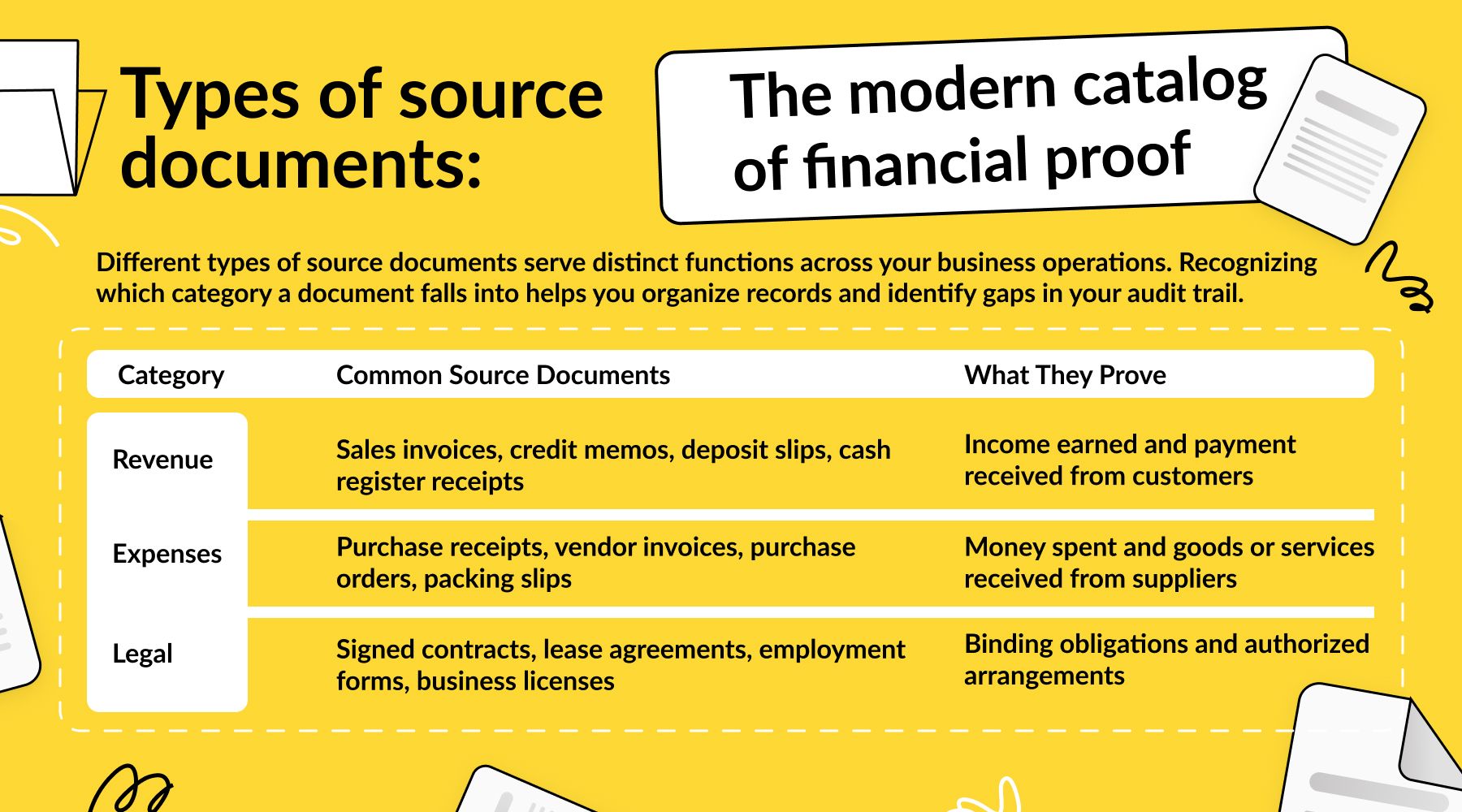
Types of source documents: The modern catalog of financial proof
Different types of source documents serve distinct functions across your business operations. Recognizing which category a document falls into helps you organize records and identify gaps in your audit trail.
| Category | Common Source Documents | What They Prove |
|---|---|---|
| Revenue | Sales invoices, credit memos, deposit slips, cash register receipts | Income earned and payment received from customers |
| Expenses | Purchase receipts, vendor invoices, purchase orders, packing slips | Money spent and goods or services received from suppliers |
| Legal | Signed contracts, lease agreements, employment forms, business licenses | Binding obligations and authorized arrangements |
Revenue documents establish your income stream, proving you earned what you reported. Every sale should generate an invoice or receipt showing who paid, what they purchased, and when payment cleared. Credit memos documenting returns or adjustments complete the picture by explaining revenue reductions.
Expense documentation justifies what you spent and why. Vendor invoices contain the purchase details, while packing slips confirm delivery of physical goods. Purchase orders provide the front-end authorization, showing the expense was deliberate and business-related, not personal.
Legal source documents prove obligations and permissions. Employment contracts establish compensation terms, lease agreements verify occupancy costs, and licensing documents demonstrate you're authorized to operate. When a received contract spans 100 pages of legal language, extracting the essential financial terms — payment amounts, due dates, penalty clauses — becomes time-consuming. Using a PDF summarizer extracts source data (the specific numbers and dates you need for your records) in seconds rather than hours.
Managing source documents: The browser-first digital workflow
Unlike desktop software requiring installation, modern source document management happens entirely in your browser. This approach delivers immediate access from any device — laptop, tablet, or phone — without the friction of app downloads, version updates, or compatibility concerns.
A typical browser-based workflow looks like this:
- Receive a document via email or vendor portal.
- Open it directly in a browser viewer for verification. If the document is a scanned receipt or image-based PDF, run it through a PDF OCR tool first to convert it into searchable, selectable text — otherwise you won't be able to verify details or search for specific amounts later.
- Check for complete 5 Ws coverage.
- Organize and rename the file using a clear convention (datevendoramount format works well).
- Store it in your chosen system with logical naming for easy retrieval.
The entire process takes seconds per document — critical for any small business owner juggling document collection across multiple vendors. By digitizing source documents and keeping them in a digital format, you eliminate the chaos of paper filing. Browser-based tools provide encryption during transfer and reliable document storage. You digitize, verify, and move on. No application consuming hard drive space, no software updates interrupting your workflow, no platform-specific limitations restricting where you can work.
Managing records through OnlyDoc eliminates the need for downloading applications. This browser-first approach means you're never locked to a single device or waiting for IT approval to install new software — critical advantages for entrepreneurs working across multiple locations or devices.
International compliance and global audits
Global entrepreneurs face a unique challenge when collecting source documents from international vendors. Using source documents from foreign suppliers means you must include documents in both the original language and an English translation to satisfy domestic tax authorities. Purchase from a supplier in Tokyo, Berlin, or São Paulo, and the invoice arrives in Japanese, German, or Portuguese. Your local tax authority won't accept documentation they cannot read.
During an audit, examiners need to verify both the transaction itself and its business purpose. A receipt entirely in Japanese proves money changed hands, but it doesn't communicate to an IRS auditor what you purchased or why it served a legitimate business function. Tax authorities can — and do — deny deductions when source documents lack English translation, treating the expense as unverifiable.
The solution involves creating a bilingual audit trail. Maintain both the original foreign-language document (preserving the authentic source record) and an English translation that clearly labels the vendor, itemizes what was purchased, and explains the business purpose. Both versions together satisfy audit requirements: the original proves authenticity, the translation demonstrates transparency.
Using a PDF translator creates audit-compliant bilingual versions, showing the expense purpose clearly to tax authorities. This approach protects international deductions while respecting the requirement that all source documents remain readable to those reviewing your financial records. Modern compliance demands accessibility, not just retention.
Retention rules: How to collect and manage source documents long-term
Tax law establishes specific retention timelines based on the type of transaction and potential audit exposure:
3 years covers standard business receipts and invoices. This matches the IRS general statute of limitations — the window during which they can audit your return and assess additional taxes.
6 years applies if you underreport income by 25% or more. The IRS extends its audit period when substantial underreporting creates higher tax liability risk.
7 years protects bad debt deductions and securities losses. These specialized deductions face longer scrutiny periods because they're frequently disputed.
Indefinitely means forever for certain critical documents: business licenses, incorporation papers, property records, trademark registrations, and documents supporting ongoing legal obligations. These records establish your right to operate and own assets, with no expiration on their relevance.
Note that state tax authorities sometimes impose retention periods exceeding federal minimums. California, for instance, can audit up to four years back for sales tax matters. Research your specific state's requirements or default to the longest applicable timeline.
Digital storage eliminates the physical space concerns that once made "keep everything forever" impractical. Modern cloud systems let you retain decades of source documents without filing cabinets, making longer retention periods a strategic choice rather than a burden.
The 60-second audit prep: The intelligent audit-ready sidebar
Most businesses approach source documentation reactively — file everything away and hope it's complete when auditors eventually request it. A smarter methodology involves proactive verification at the moment documents arrive.
The Verification Sprint takes 60 seconds per document and catches gaps while transactions remain fresh and correctable:
- Open the document in your browser viewer immediately upon receipt.
- Confirm all 5 Ws are present and legible: Who (both parties named), What (specific goods/services described), Where (address or jurisdiction shown), When (date clearly stated), Why (business purpose evident or noted).
- Flag incomplete documents for immediate vendor follow-up — request missing information before filing.
This rapid verification prevents the nightmare scenario of discovering missing elements months later during tax prep or, worse, mid-audit when the vendor relationship has ended and reconstruction becomes impossible. Fixing gaps takes minutes when the transaction is fresh; it takes days or becomes impossible when you're scrambling six months later.
The proactive approach transforms source documentation from a compliance chore into an early-warning system. Each verified document becomes a small insurance policy against future audit findings, building a fortress of financial integrity one receipt at a time.